

Jose & Stephanie
Jose & Stephanie
Q + A

📜 A Note Before You Dive In
We've done our best to answer the most common questions below, but for the most current and comprehensive information about getting around, places to stay, local dining, and everything the region has to offer, we highly recommend visiting the Carcassonne Office of Tourism website. Their team is an incredible resource and will have the most up-to-date details to help make your trip to this corner of southern France as seamless and magical as possible.
If you have any specific questions, feel free to email us at ouitofrance26@gmail.com.
---------------------------------------------------------------------------

Does Carcassonne Have an Airport?
Yes! Carcassonne Airport (CCF), also known as Salvaza Airport, is located just 3km west of the city and is a convenient option for guests flying from certain European cities. Current non-stop routes serve 10 destinations from 6 different countries, with Ryanair as the primary carrier, connecting Carcassonne to cities including London-Stansted, Manchester, Dublin, Brussels Charleroi, and Porto. Please note that a lot of these flights are seasonal. A shuttle bus service runs from the airport to the city center and train station, timed to coincide with flight arrivals.
---------------------------------------------------------------------------

What if I don't want to fly directly into carcassone?
No problem at all! Toulouse is the most popular alternative — it's about one hour from Carcassonne and offers far more frequent international connections from the Toulouse-Blagnac Airport. From Toulouse, you can take the airport shuttle to Toulouse Matabiau train station, then catch a train to Carcassonne, with services running roughly every 90 minutes. Other nearby airports include Béziers Cap d'Agde (about 1 hour away), Perpignan (about 1 hour), and Montpellier (about 2 hours).
---------------------------------------------------------------------------

What is carcassonne known for?
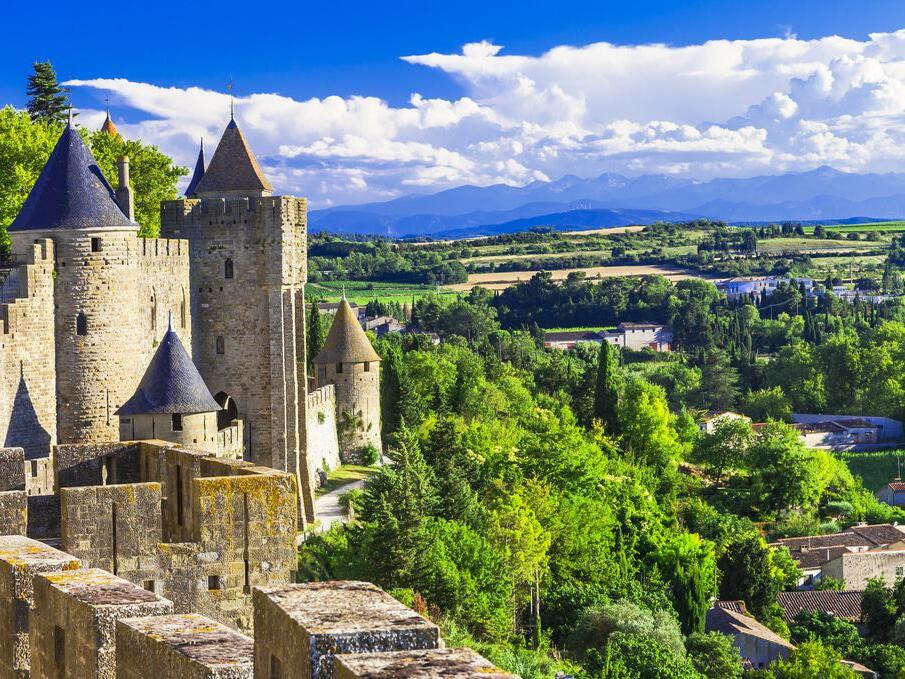
Carcassonne is one of the five most visited cities in France, famous for its extraordinary medieval heritage — including two UNESCO World Heritage Sites: the medieval fortified city and the Canal du Midi. The Château Comtal fortress stretches over 3 kilometers and features 52 towers, while the Basilica of Saint-Nazaire houses stunning 13th and 14th century stained glass considered among the finest in southern France. Orguesfrance Beyond the ramparts, the surrounding Aude countryside is dotted with vineyards, Cathar castles, and charming medieval villages — including Montréal, where the ceremony will take place!
---------------------------------------------------------------------------

Will I need a car rental?
It depends on how much you plan to explore. The wedding venues are located in the countryside, so having a car will give you the most flexibility. There will be transportation provided on the day of the wedding from the Cite (or castle) to the church, then the reception venue, and returning to the Cite at the end of the evening. If you would like to explore car rental options, you can do so via the Carcassonne Occitanie Airport Website.
That said, Carcassonne's train station offers connections to major cities across the region and taxis, via G7 App, as well as Uber's are available. We recommend renting a car if you'd like to visit the surrounding villages, vineyards, and Cathar castles at your own pace.
---------------------------------------------------------------------------

Will I need to exchange currency?
France uses the Euro (€). France is largely cashless, and credit and debit cards are widely accepted at restaurants, hotels, and shops. ATM's are widely available at airports, train stations, and throughout towns. It's best to wait until you arrive to withdraw euros from an ATM rather than exchanging currency before your trip, as airport exchange bureaus and stateside banks often offer unfavorable rates. Keep in mind that any credit or debit cards may charge you an international exchange fee. It's best practice to check your credit or debit card terms and conditions so that you are aware of any additional fees that you may incur.
That said, it's a good idea to carry some cash for small purchases, market vendors, and tips (e.g. Taxi's). US dollars are not accepted in most establishments in France so make sure to have euros on hand for your stay.
---------------------------------------------------------------------------
What will the weather be like for the weekend of the wedding?
September is one of the best times of year to visit the Carcassonne region! In mid-September, average daytime highs hover around 25°C (77°F), with cooler evenings dropping to around 15°C (59°F). There's roughly a 20% chance of rain on any given day, and when it does rain, it tends to be light. You can expect around 8 hours of sunshine per day.
We'd suggest light layers for the evening — a linen blazer or a light wrap will go a long way. Ladies, keep in mind that the château grounds include cobblestone and grassy areas, so comfortable footwear is a great idea!
---------------------------------------------------------------------------

Do I need a visa to travel to France?
US citizens with valid passports can enter France without a visa for stays up to 90 days. However, there is an important new requirement to be aware of for 2026. The EU is introducing ETIAS (European Travel Information and Authorization System) in the last quarter of 2026 — the exact launch date will be announced at least six months in advance. Since our wedding is in September 2026, ETIAS may or may not be in effect by then — we'll update this page as soon as we know more.
If ETIAS is required, don't worry — the application is fully online, takes only a few minutes, and costs €20. Once approved, it's valid for three years and linked electronically to your passport.
In the meantime, make sure your passport is valid for at least three months beyond your intended departure date from the Schengen Area — and we recommend at least six months to be safe. Check back on this page for updates as we get closer to the date!